We develop an Activity-based Modeling, Simulation and Learning (AMSL) methodology, where activity captures additional information that supports the analysis and explanation of component behavior and decision-making in complex systems.
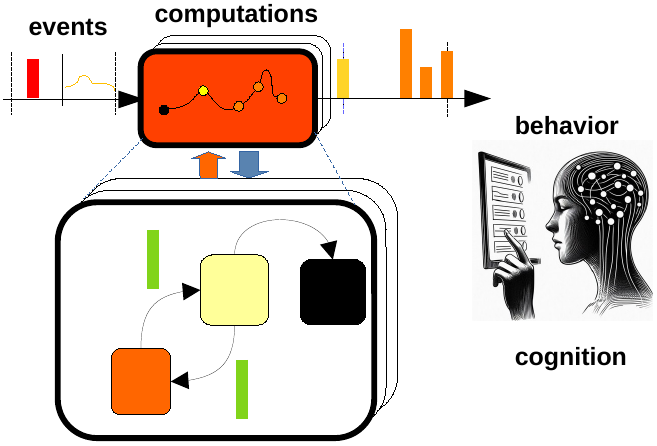
Modeling
Our methodology (see the iterative specification in Theory of modeling and simulation book) guides the hierarchical decomposition of a model structure into networks of sub-models, from input-output behaviors to neworks of sub-models. Inversely the abstraction of networks of sub-models into a simplified model can be studied. This framework allows constructing proofs of frugal computational activity of the models. Using timed events, different precise computational activity patterns of coordination between sub-models can be studied to explain a model’s overall behavior.
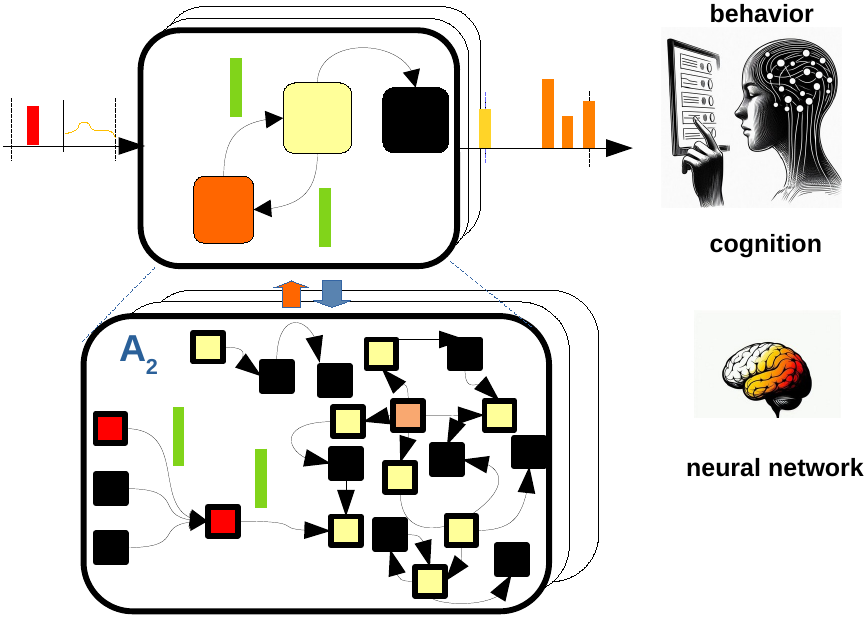
Simulation
Tracking the relevant activity in networks of submodels (e.g., neurons), simulations, with sparse computations, are achieved for the models developed at modeling step. Using this approach allows simulating a billion of stochastic computational processes instead of usual ten or so.
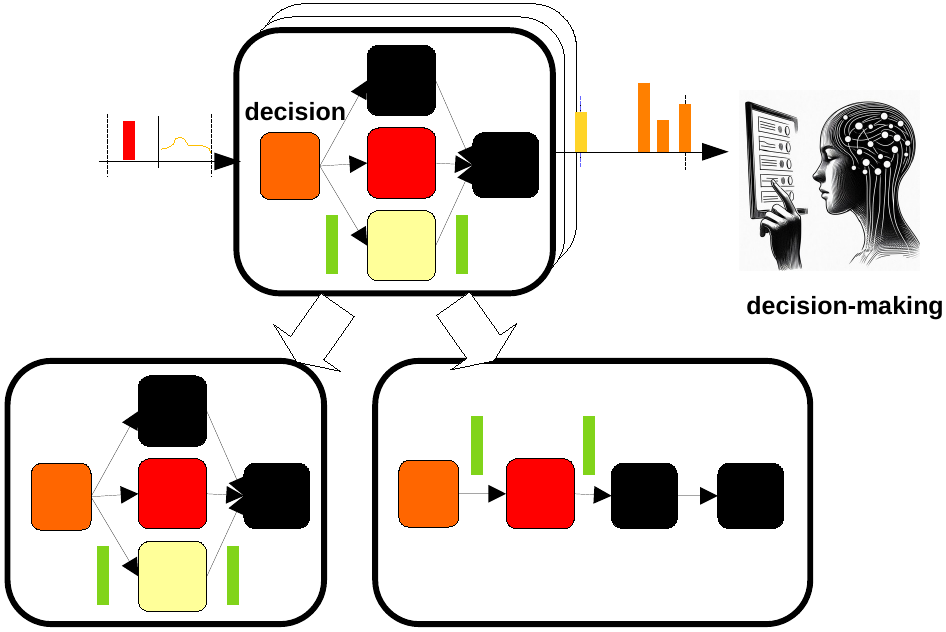
Learning
In reinforcement learning, it can be difficult to bring closer computational structures to real decision-making, or to the behavior of complicated mechanisms. Our approach allows decomposing a decision-making process, or the behavior of a complicated mechanism, into basic parallel or series structures of individual decisions (with or without dependencies), or individual components of the complicated mechanism, Using activity allows then to study precisely the flow of computations between the individual components, for bringing closer computational structures and their activity to the activity (number of decisions, spiking rate of a neural network, etc.) of the real system.
Theory of modeling and simulation book
Theory of modeling and simulation presents a good general introduction to our methodology of computational modeling and simulation.
 Alexandre Muzy